

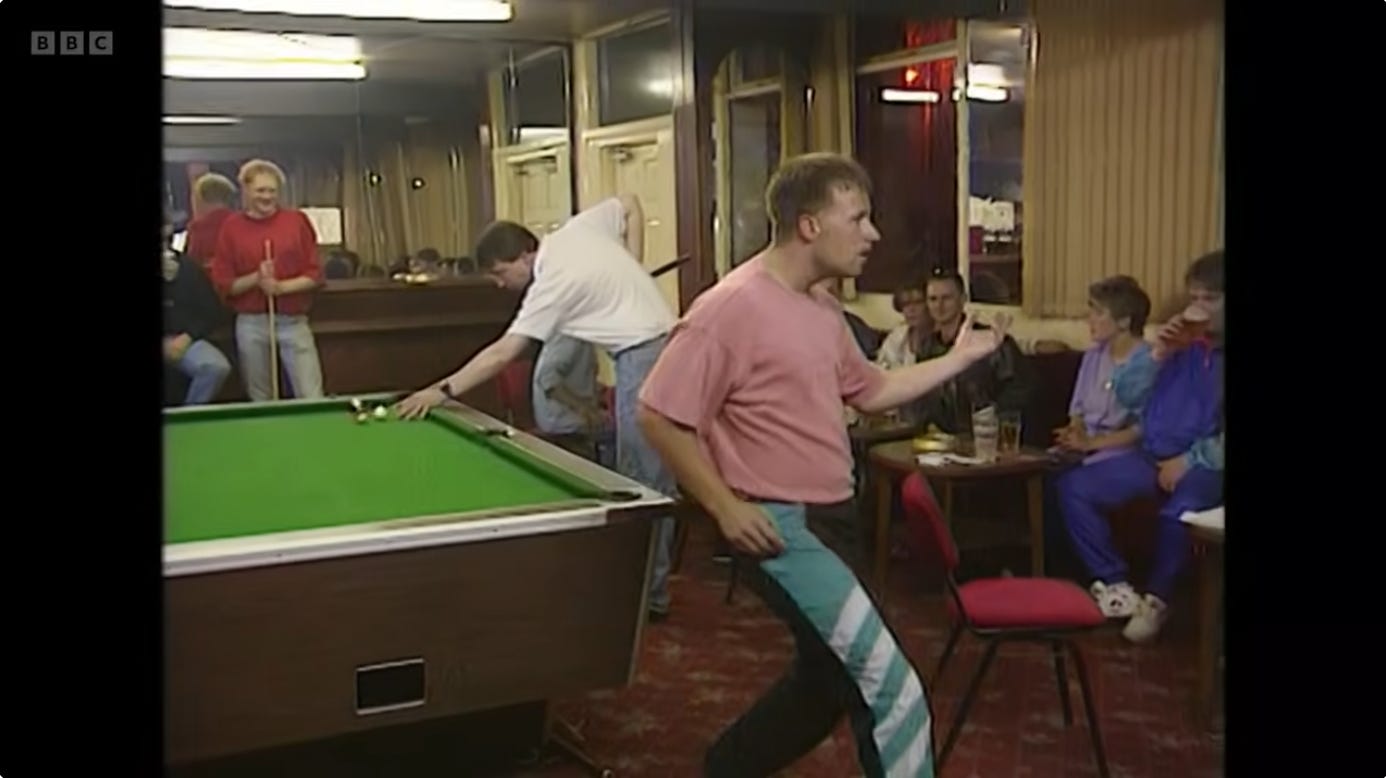
If you’re from the UK you should watch Shifty, the latest documentary series by Adam Curtis. If you’re not from the UK, you should still watch it. It will teach you about what culture is, in that it demonstrates what culture isn’t, by painting the negative space around it, in the shape of Great Britain.
Shifty is a comprehensive survey of life in Britain in the latter half of the 20th century. This is when Thatcher held the country tight in her bony grip and beat out of it whatever life may have been left. After decades of horror and depravity, Blair took over and things looked hopeful for a second. Then everyone’s favourite princess died and that was kind of it. In the series, as the turn of the century approaches, we repeatedly return to footage of ditsy Britons in a board room trying to think of what to put in the Millennium Dome — a structure in North Greenwich famous for how ugly it is.
The Millennium Dome opened on the 31st of December 1999 and closed exactly a year later. It was a sprawling museum packed with exhibits all about the future, based on the present; a 20th century imaginary of 21st century life. But most importantly it was about Britain. The exhibits were meant to represent three key things: who we are, what we do, and where we live. The Britons in the board room stared blankly at each other, lost for answers, barely able to comprehend the question, practically evaporating due to the sheer lack of substance in the room. The contours of British life eluded them. Anyway, The Dome is a shopping centre now. It’s known colloquially to consumers as ‘The O2’, because I guess it looks how a mobile network feels (frustrating and not worth the money).
We’re at another cultural precipice in the UK now: The Conservatives have finally been binned off after a prolific run of hatefully trolling the entire country, and Labour have spent their first year in power pissing it up the wall. This is all normal of course, but now we have the added noise of the internet: a machine of perpetually groaning background static that contains all of modern day discourse. Labour, the party in the UK that was traditionally built to represent the working class, is now losing ground to Reform — a far-right party who produce background static faster and louder than anyone else. But obviously this is a lot more complicated that just who is posting what online. My good friend Claddagh recently wrote an excellent piece that attempts to explain what’s happening here: progressives are bent on doing politics AT you, assuming that if you just had all the facts you will fall in line. While messaging from the far-right does all the things that effective fascist propaganda does: it tells you that your culture — the very thing that makes you who you are — has been squandered by an invisible enemy. She writes:
Progressive politics has a habit of treating culture as something abstract or symbolic; as a secondary concern that can be overridden by good policy design. But culture is not an optional layer on top of material life. It is how people make sense of change, loss, pride, and continuity in ordinary terms. When cultural attachment is treated as trivial, or worse as dangerous, it is experienced not as a liberal moral enlightenment, but as erasure. Culture is ordinary, and it the identity it fosters belongs to ordinary people. That is precisely why it matters.
Reform are pushing back on this alleged cultural erasure with hate. There is no limit to what they can hate. They even seem to hate the UK itself, literally referring to is as lawless, as if we are stuck in a violent doom loop beyond hope. Luckily our culture isn’t yet eroded enough to stop us from making movies: I just watched the most recent 28 Years Later film, which depicts a UK that is isolated and decaying because it has been overrun with a ‘rage virus’ for nearly three decades. No one can get in or out; the country is totally self-sufficient and men are made by hunting the infected. It’s like a bizarre mixture of what Reform want for the future (which I guess is sovereignty no matter the cost), but also what they want us to believe about the present (That the UK is dangerous and diseased). Here is a shot of a car park from the film:

It’s very tempting to characterise these films as visions of a Britain that stopped producing culture in 2002. What actually stopped was infrastructure: there’s no factory farming, no energy grid, no telecoms, and also no media. Without media you have no spectacle. In this alternate reality, the famous Sycamore Gap tree was never illegally cut down by two idiot men — I guess because everyone was too busy trying to stay alive — but also because without the internet’s infinite gaze, destructive attention-seeking stunts have no value. So yes, everything’s broken and nothing works, but equally everyone has given up extracting from nature. Danny Boyle really made post-apocalyptic Britain look beautiful. I can’t wait for the real apocalypse, honestly.
When in crisis, culture does not disappear. It goes even harder. If all media is eventually lost, all your television favourites live in your head as slowly dulling memories, and are relegated into oral history. Now everything is just stories at the dinner table. The main antagonists in the latest film seem to enjoy remembering the Teletubbies, albeit in a demented, childlike way. They also dress up as 1970s media personality Jimmy Saville, because the public hadn’t been given the chance to learn that he was a paedophile. In apocalyptic Britain Jimmy Saville is still a great entertainer from the past. The Queen is still alive, because there is no way to announce that she is dead. No one has had to suffer James Corden. Disgusting piss-swilling clip show Little Britain never got the chance to air. Jamie Oliver never got the chance to become infuriating and classist on TV and is perhaps remembered fondly instead.
Of course the apocalypse isn’t all sunshine and rainbows: one character feels so lonely that he fabricates companionship by continually drugging one of the infected with a tranquiliser. He struggles to remember a time when there were shops, communities, and having a purpose beyond just trying to stay alive. It was like watching someone trying to foster a meaningful connection with ChatGPT. It obviously goes much deeper than this but there’s no need for spoilers.
Back in our reality, human incubator for centrist flop-sweat Keir Starmer will have us believe that living in fear and isolation is good, actually. He’s never met an AI solution he doesn’t like. He is to AI what Blair was to George W Bush — very eager to please. At least when Blair said “I’m with you, no matter what” it was to a human, and not into the input field of a chat bot interface. And just recently our warm and loving Home Secretary Shabana Mahmood announced that she just can’t wait to “achieve, by means of AI and technology, what Jeremy Bentham tried to do with his panopticon”. So we’re just openly admitting that we are aiming for actual dystopia now, brilliant, okay.
Things feel kind of hopeless right now because the only one proposing alternatives to the above is Nigel Farage, a man who thinks that all British culture begins and ends with having a pint and being racist. We literally deserve so much better. Not in a ‘let’s go back to the good old days’ sense — just that no one deserves to be told that they live in a cultureless sinkhole over and over again. The UK is actually dripping in culture, but maybe the few dwindling good parts are hard to see right now. Which is why we really need to remember them if we’re going to survive the imminent apocalypse. Just relax and let Gemma Collins into your life for once. Have a Nandos; have a roast. Remind yourself that there are a thousand iconic drag acts happening in local pubs up and down the country right now. The UK defined what a rave is through our sheer desire to party, maybe try and be proud of that for five minutes. Or do yourself a favour and listen to the hosts of Off Menu interview Claudia Winkleman, it’s so fucking funny. Oh and also visit the New Forest when you get a chance, those landscapes are excellent.
This article comes at the perfect time, your dissection of culture and the struggle for a national identity is incredibly sharp and timely, honestly. I'm still processing the 'negative space' concept – it’s a powerful debug tool for understanding what something isnt, but how do you then isolate the positive definition without getting lost in abstration?